Compare fields B and 4 on the Greek registration certificate: if they differ, the car was imported. What that means for your used car inspection.
Greek used-car listings often say “Greek dealer car” (ελληνικής αντιπροσωπείας), but plenty of used cars on the market came from Germany, the Netherlands or Italy. Either can be a good buy. You do need to know which one you are looking at, though, because an imported car has a part of its life that Greek records know nothing about. You don’t have to take the seller’s word for it: the answer is printed on the registration certificate (άδεια κυκλοφορίας), in two fields.
The rule: compare fields B and 4
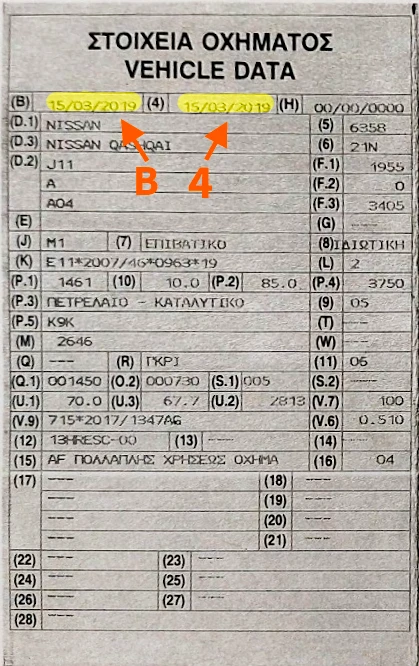
On the “Vehicle data” (Στοιχεία οχήματος) page of the Greek registration certificate there are two dates that look alike but mean different things:
- Field (B): the date of first registration of the car, in any country. It is the day the car got its first number plates.
- Field (4): the date of first registration in Greece, the day it got Greek plates.
The rule is simple:
- Same date: the car was first registered in Greece, as a new car. This is what the Greek market calls a “Greek” car.
- Different dates: the car was driven in another country first and came to Greece later as a used car. It is imported, whatever you are told.
A real example
On the certificate above, for a Nissan Qashqai, field (B) reads 15/03/2019 and field (4) also reads 15/03/2019. The two dates match, so the car was registered new in Greece and its whole history is here.
If you read (B) 10/06/2016 and (4) 22/02/2021 instead, you would know the car spent almost five years in another country before coming to Greece. For those five years, Greek records have nothing to tell you.
Don’t confuse fields (B) and (4) with other dates on the certificate, such as field (H), which reads 00/00/0000 on most private cars. Compare only (B) with (4).
Why it matters whether a used car is imported
An imported car is not automatically worse. Many have been looked after well and come with better equipment than their Greek equivalents. The difference is that their history is harder to check.
1. The mileage history has a gap
Mileage readings at Greek roadworthiness tests (KTEO) and Greek workshops start from the date in field (4). Anything before that was recorded in another country, if it was recorded at all. This gap is why odometer rollback is more common on imported cars.
2. Damage abroad doesn’t show up here
A car that was badly crashed or flooded in another country can be repaired and sold in Greece without a single Greek record of the damage. This is where a paint thickness gauge and a check of the chassis tell the truth.
3. Different driving conditions
In northern Europe, roads are salted in winter. Salt speeds up corrosion under the car: on the brakes, the brake and fuel lines, and the suspension mounts. An imported car needs a careful look underneath, with the car raised.
4. Price and resale value
In Greece, “Greek” cars usually sell for more than comparable imported ones, and that will still be true when you come to sell. If the seller is asking a Greek-car price for an imported car, you have a solid, documented argument for negotiating the price.
5. The seller’s honesty
If the ad says “Greek” and fields (B) and (4) differ, something is off. It may be simple carelessness, but it is a good reason to check everything else twice as carefully.
What to ask for if the car is imported
- The documents from the country of origin: the old registration certificate, and the customs clearance papers.
- The service book and invoices: even in a foreign language, the dates and mileages are easy to read.
- Foreign roadworthiness reports: for example TÜV or DEKRA reports from Germany, which record the mileage.
- A history check by chassis number (VIN): many dealers can see their network’s service history from the VIN, and there are international vehicle history services.
Also check that the chassis number on the certificate, in field (E), matches the one stamped on the car itself. See the full list in our article on the documents to ask the seller for.
The used car inspection before you buy
The paperwork tells you where the car came from. Only an inspection tells you what condition it is in. In a professional used car inspection we:
- read the mileage stored in the car’s electronic modules with a diagnostic tool and compare it with the odometer,
- measure the paint thickness on every panel to find repairs,
- check the chassis and the underside for rust, impact damage and repairs,
- check the engine, gearbox, suspension and brakes, and take the car on a test drive,
- compare the details on the registration certificate with the car itself.
For an imported car this inspection is worth even more, because it covers the part of the car’s history that Greek records don’t show. CarCheck carries out an on-site used car inspection anywhere in Attica, wherever the car is, at a dealer or a private seller, and gives you a written report. See how the inspection works.
Before you go to see a car, ask the seller for a photo of the registration certificate and look at fields (B) and (4). It takes a minute and can save you a wasted trip.
Frequently asked questions
What does field B on a Greek registration certificate show?
Field (B) shows the date of the car’s first registration, in any country. It is the day the car got its first number plates.
What does field 4 on a Greek registration certificate show?
Field (4) shows the date of first registration in Greece, the day the car got Greek number plates.
If fields B and 4 differ, is the car definitely imported?
Yes. If the date in field (4) is later than the date in field (B), the car was first registered in another country and imported into Greece as a used car.
Is an imported used car a bad buy?
Not necessarily. Many imported cars are in very good condition. But because their history before Greece doesn’t appear in Greek records, they need a more careful check of the mileage, the paintwork and corrosion before you buy.
Can CarCheck inspect an imported car?
Yes. We carry out on-site used car inspections anywhere in Attica, whether the car is Greek or imported, and give you a written report. Book online or call +30 210 522 1663.