A practical guide to used car inspection: from the service history to paint thickness, the 10 points to check before you buy a used car in Greece.
Buying a used car is one of the biggest purchases most people make, and one of the riskiest. The seller has known the car for years; you see it for half an hour. That information gap is exactly where the expensive surprises hide. Below are the ten points we check on every vehicle, and that are worth checking yourself before you pay a deposit.
Keep this list on your phone when you go to see a car. You don’t need to be a mechanic to notice most of these things; you need time, good light and the willingness not to rush. Where a check needs equipment we say so, so you know what you can see for yourself and what needs a professional.
1. Service history and service book
A car with a full, stamped service book and workshop invoices is worth more than the same model with no history. Ask to see the stamps, the dates and the mileage at each visit. The intervals should make sense and the mileage should rise steadily from one entry to the next.
Pay particular attention to the major jobs: timing belt or chain replacement, gearbox fluid, brake fluid. A timing belt is usually replaced every 60,000 to 150,000 km or after a set number of years, depending on the manufacturer. If the car is past that point and there is no proof of replacement, factor the cost into the price.
2. Mileage that matches the wear
The odometer is just a number on a screen. What matters is whether it agrees with everything else. A steering wheel polished by use, worn pedals, a sagging driver’s seat and a worn gear knob don’t go with 60,000 km. Compare the reading with the roadworthiness test (KTEO) certificates and the entries in the service book.
Odometer rollback is still one of the most common scams. We explain in detail how to spot it in our article on odometer tampering.
3. Bodywork, panel gaps and paint thickness
Look at the car in daylight and from a low angle. Uneven gaps between doors, bonnet and wings, differences in shade or gloss, and paint on rubber seals and plastic trim are signs of repair. Check the bolts on the hinges and wings too: if they have spanner marks, a panel has been removed.
The eye isn’t enough, though. An electronic paint thickness gauge shows precisely where there is repainting or filler. Read what a paint thickness gauge reveals.
4. Underneath: rust, leaks and impact damage
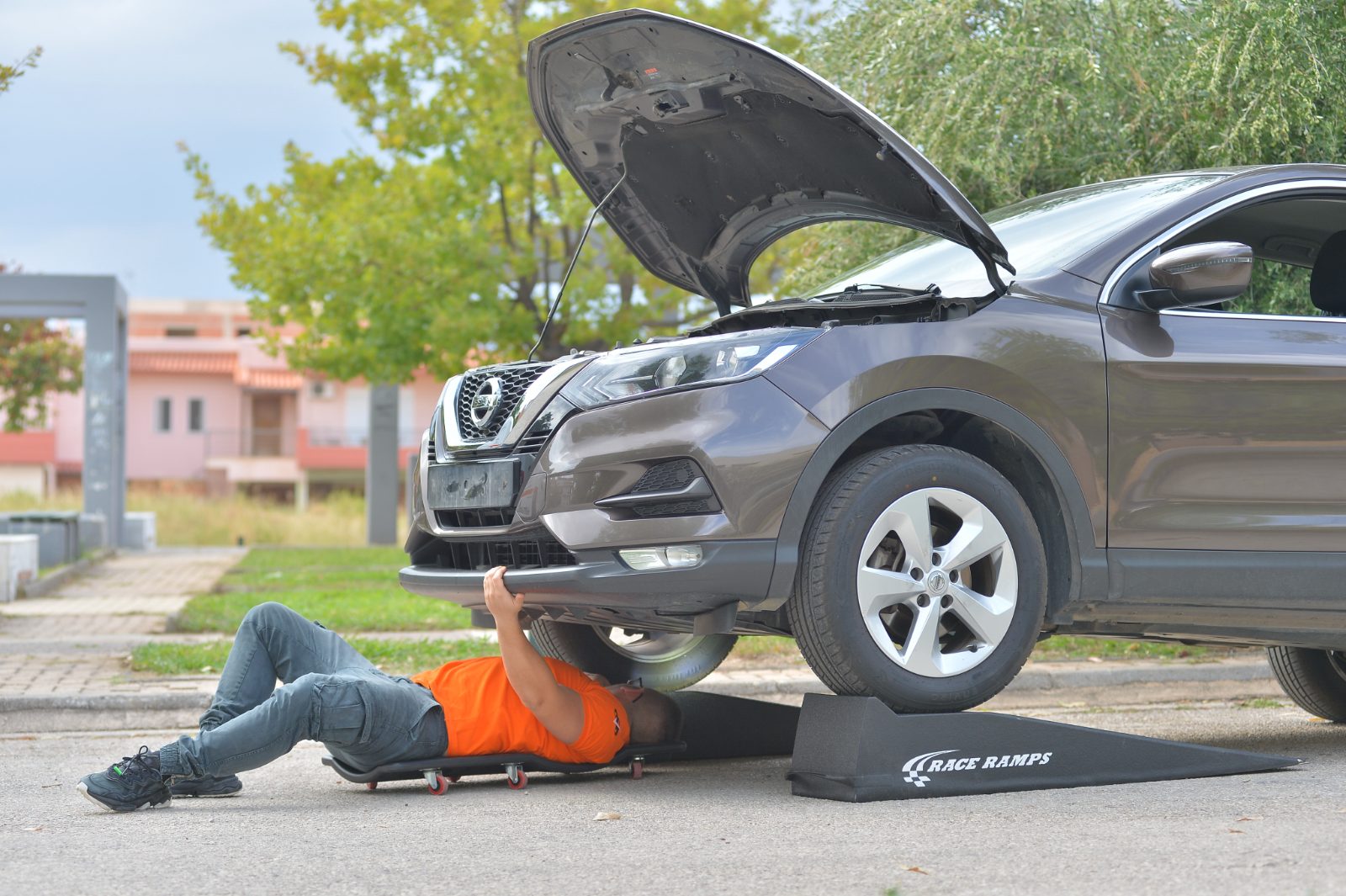
The underside of the car tells the truth that shiny bodywork hides. Rust on the sills and floor, bent wishbones, a dented exhaust, oil leaks from the sump and gearbox, or coolant leaks are all signs you won’t see unless the car goes up on a lift. In our full inspection the car is raised for exactly this reason.
5. The engine from cold
Ask to see the car with a cold engine. Many problems, such as hard starting, timing chain noise or a rough idle, hide once the engine has warmed up. If the seller “just ran it a moment ago”, ask to come back.
Watch the exhaust at start-up. A little white vapour in cold weather is normal, while blue smoke means the engine is burning oil and heavy black smoke points to a combustion problem. Open the bonnet: check the oil level and appearance, the coolant, and whether there is “mayonnaise” under the oil filler cap, a possible sign of a head gasket problem.
6. Electronics and diagnostics
A warning light that is off on the dashboard doesn’t mean there are no faults. The car’s control units store fault codes even when the light has gone out or been “cleared” just before the sale. A diagnostic check with professional equipment reads every module: engine, gearbox, ABS, airbags and comfort systems.
Also check everything electrical: windows, mirrors, central locking, lights, infotainment, camera and parking sensors. A battery near the end of its life often causes phantom faults, which is why we always test it.
7. Suspension, steering, brakes and tyres
Look at the tyres: uneven wear on the inner or outer edge points to an alignment or suspension problem, which may also come from an old impact. Check their manufacturing date (the four-digit DOT code); tyres more than six years old need replacing, however much tread they have.
On the road, the steering should hold a straight line without corrections, the brakes should bite evenly without vibration through the pedal, and the suspension shouldn’t knock over potholes.
8. Gearbox and clutch
On a manual gearbox, gears should engage smoothly, without grinding. A clutch that bites very high or slips under acceleration is near the end of its life. On automatic and dual-clutch gearboxes, watch for delays, jerks and harsh shifts, especially at low speed and when parking. Repairing them is among the most expensive jobs on a used car.
9. Interior, air conditioning and damp
A musty smell, damp carpets or misted lights can mean a water leak or, in the worst case, a flood-damaged car. Lift the boot floor and look for rust or mud. Turn the air conditioning to cold: it should cool within a few minutes and the compressor shouldn’t be noisy. Check the heating, the seat belts and the seat adjustments too.
10. Documents and legal status
A car can be mechanically perfect and still be hard to transfer. Make sure the seller is the owner named on the registration certificate, that the chassis number on the certificate matches the one on the car, that the roadworthiness test is valid and that road tax has been paid. We cover the documents to ask for in our article on the documents to ask the seller for.
The test drive completes the picture
No inspection is complete without a road test: town, a hill, a main road and, safely, some hard braking. In our article on the right test drive in 10 steps you’ll find a checklist so nothing slips past you.
When it’s better to walk away
Some signs aren’t just a reason for a discount; they’re a reason to keep looking. If you come across any of the following, think hard about whether the risk is worth it:
- The seller refuses an inspection by an independent mechanic, or is in a great hurry to close the deal.
- The chassis number on the car doesn’t match the registration certificate, or looks tampered with.
- There are signs of flooding: mud under the seats, rusty screws inside the cabin, corroded connectors.
- The chassis or suspension mounting points are badly corroded or show signs of extensive repair.
- The odometer reading differs from the service history and the seller has no convincing explanation.
- The price is far below the market for no obvious reason.
A good deal isn’t lost because you asked for an inspection. A seller with a clean car usually agrees without a second thought, because they know it will confirm what they told you.
Why an independent used car inspection is worth it
However careful you are, some things can’t be checked without equipment: the underside without a lift, the fault codes without a diagnostic tool, the paint without a gauge. An independent mechanic has no interest in whether the car sells or not; they simply tell you what they found.
CarCheck comes to wherever the car is, anywhere in Attica, and gives you a written report with photos. See what the used car inspection covers or book an inspection.
And if the inspection finds problems, the report becomes your strongest argument on price. See how to negotiate the price with evidence.
Frequently asked questions
How long does it take to check a used car?
If you do it yourself, allow at least an hour including the test drive. A professional inspection with a diagnostic tool, a paint thickness gauge and a lift usually takes one to two hours, depending on the package.
Can I check a used car myself?
Many of the 10 points, such as the service history, panel gaps, the interior and the test drive, you can check yourself. The underside, the control unit fault codes and the paint thickness need equipment.
Where does CarCheck carry out used car inspections?
Anywhere in Attica, wherever the car is: at a car lot, a dealership or a private seller. After the inspection you get a written report with photos. Book online or call +30 210 522 1663.