
What to listen for and feel on a test drive, the most revealing part of a used car inspection before you buy, in 10 steps.
The road test is when the car “talks”. Noises, vibrations, hesitations and smells you won’t notice in the car park show up within a few kilometres, as long as you know what to look for. The problem is that most buyers do a short lap around the block, chatting with the seller, and come back with a general impression. Here is a ten-step guide to a test drive that actually reveals problems.
Before you set off
Arrange the test drive in daylight, with at least 30 to 40 minutes to spare. Make sure the car is insured and that you have your driving licence with you. Ask for the engine to be cold when you arrive; if the bonnet is already warm, ask why. Switch off the radio and politely ask the seller to let you concentrate.
Before you get in, walk around the car and check that it sits level, that the tyres look properly inflated and that there are no drips on the ground where it was parked. Adjust the seat, steering wheel and mirrors so you can drive comfortably and safely.
Step 1: The cold start
Turn the key to the first position and check that all the warning lights on the dashboard come on, and that they go out after the engine starts. A light that doesn’t come on at all may have been removed to hide a fault. The engine should start straight away, without a long crank, and the idle should settle within a few seconds. Listen for metallic noises in the first seconds, a possible sign of a timing chain problem.
Step 2: Exhaust and idle
Ask someone to press the accelerator lightly while you watch the exhaust. A little white vapour in cold weather is normal. Blue smoke means the engine is burning oil, heavy black smoke points to a combustion or injection problem, and continuous white smoke with a sweet smell suggests a coolant leak. At idle, the engine shouldn’t shake or hunt up and down.
Step 3: Clutch and first gear changes
On a manual gearbox, notice where the clutch bites. If it bites very high, it is near the end of its life. Gears should go in without resistance and without grinding. On an automatic, moving from P to D and to R should give a gentle “click”, not a thump.
Step 4: Low speed and parking
Manoeuvre in a car park with the steering on full lock in both directions. Clicking from the wheels can point to worn CV joints, while a whine or heavy steering suggests a power steering problem. On dual-clutch gearboxes, jerking when pulling away and in reverse is a common first sign of wear.
Step 5: Town driving
When stopping and pulling away, the car should move smoothly. Watch how the gearbox behaves in the low gears, the engine temperature, which should reach its normal value and stay there, and the start-stop system, if fitted.
Step 6: Suspension on a rough road
Choose a road with potholes or speed bumps and drive over them slowly. Knocks, creaks and a car that keeps bouncing after the bump point to worn shock absorbers, drop links or bushes. Also listen for noises from inside, such as creaking plastic trim, which may be an annoyance rather than a fault.
Step 7: Acceleration and a hill
On a hill or a slip road onto a main road, accelerate hard, safely. The power should come in smoothly, without flat spots, and the revs shouldn’t rise without the speed rising with them, which points to a slipping clutch. On turbo cars, listen for a whistle that doesn’t sound normal.
Step 8: Steady speed on a main road
On a straight, at a steady speed, relax your grip on the wheel slightly, always safely. The car should hold a straight line without pulling to one side. Vibration through the steering at certain speeds usually means unbalanced wheels or a bent rim. A hum that grows with speed may be a wheel bearing.
Step 9: Brakes
On an empty road, and only if it is safe, brake hard from a moderate speed. The car should stop in a straight line without veering. Vibration through the pedal or the steering points to warped brake discs, while squealing usually means worn pads. Check the handbrake on a downhill slope too.
Step 10: After the drive
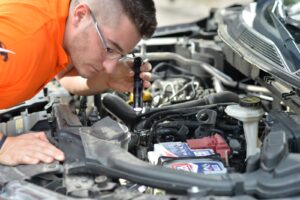
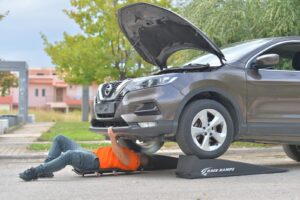
With the engine warm, leave it idling and open the bonnet. Look for oil or fluid leaks, a burning smell and steam. Look under the car for drips. Check the dashboard again for any warning lights that came on during the drive, and test the air conditioning and heating at full power.
Use all your senses
An easy way to make sure nothing slips past you is to think with all your senses:
- Hearing: knocks from the suspension, whistling from the turbo, humming from a bearing, squealing from the brakes, metallic noises from the engine.
- Touch: vibration through the steering wheel, the brake pedal or the seat, a clutch that bites high, a gearbox that jerks.
- Smell: burnt oil, the sweet smell of coolant, fuel, mustiness from the air conditioning or from damp inside.
- Sight: warning lights on the dashboard, exhaust smoke, engine temperature, drips under the car.
Hybrids and electric cars
Testing a hybrid or electric car follows the same steps for suspension, steering and brakes, with a few differences. On a hybrid, watch the switch between the electric motor and the combustion engine: it should be smooth, without jerks. On an electric car, look at the range the car shows relative to its age, and how the battery percentage drops during the drive. The real condition of the high-voltage battery, though, can only be checked with diagnostic equipment. See our article on hybrid car problems.
Take notes
After the drive, write down what you noticed straight away, even the small things. If you see more than one car, your notes will help you compare them calmly rather than on the impression of the last drive. They are also useful when you negotiate the price.
What a test drive doesn’t show
However carefully you drive, the test doesn’t reveal everything: stored fault codes that haven’t lit a warning light, rust and damage underneath, hidden bodywork repairs and the internal condition of the engine. For those you need equipment: a diagnostic tool, a lift, a paint thickness gauge, an oil analysis.
In the CarCheck Full Inspection the test drive is carried out by a specialised mechanic and combined with a lift inspection, a diagnostic check of the control units and an oil analysis. See what the used car inspection covers or book an inspection.
Remember that a test drive needs the seller’s consent and that the car must have all its legal documents in order. See which ones in our article on the documents to ask the seller for.
If the seller wants to drive
Some owners don’t let anyone else drive their car, which is understandable. In that case, sit in the passenger seat and ask to go through the same conditions: cold start, town, rough road, acceleration, main road and braking. You’ll lose the feel of the steering and the pedals, but you’ll still hear and feel most things. If the seller consistently avoids certain conditions, for example the main road, ask why.
The test drive in a used car inspection
A proper test drive takes a little over half an hour and can save you thousands of euros in repairs. Follow the steps in order, don’t let the conversation distract you, and take notes. For the full picture, also see our 10 things to check before buying a used car.
Frequently asked questions
How long should a test drive last?
At least half an hour, so you can go through a cold start, town driving, a rough road, acceleration, a main road and braking. A lap around the block reveals almost nothing.
What if the seller won’t let me drive?
Sit in the passenger seat and ask to go through the same conditions. If the seller consistently avoids some of them, for example the main road, ask why.
Is a test drive enough, or do I also need a used car inspection?
A test drive shows how the car behaves, but not rust underneath, fault codes in the control units or repairs to the paintwork. CarCheck combines the test drive with a lift, a diagnostic check and an oil analysis, on site anywhere in Attica. Book online.